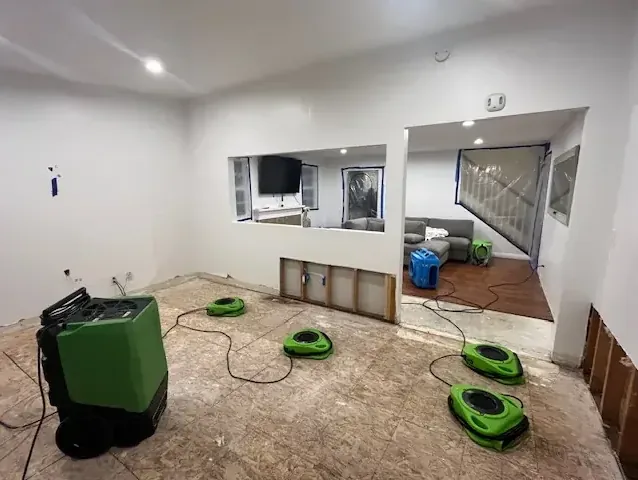
Structural drying and dehumidification

Structural Drying and Dehumidification in Auburndale

Wet drywall, subfloor and framing do not dry just because the room feels dry. Air movers and dehumidifiers work together in a humid subtropical climate, and meters track every material until it reads dry.

(888) 621-2041Phone about dehumidifier setup
Air movers Dehumidifiers Daily meter checks
Air movers and a dehumidifier running side by side in a damp room
EquipmentAir movers, dehumidifiers
Tracked withMoisture meters
Drying classesClass 1 to Class 4
Done whenReadings match dry
Typical cost

What does structural drying and dehumidification cost in Auburndale, FL?

Drying cost follows the class of the job, which depends on how much material is wet and how dense it is. Ranges below separate a single area from several rooms and from slab or block that holds water longest.

Class 1 or 2, one area
$1,000 to $3,000
  • Limited wet area
  • Few machines
  • Short run
Several rooms, Class 3
$3,000 to $7,500
  • Several rooms
  • More equipment
  • Longer run
Class 4, slab or block
$7,500 to $15,000+
  • Dense materials
  • Specialty drying
  • Extended run

What moves the number: the water category, how many square feet got wet, the material class and how soon drying began.

For a closer planning range, run the water damage cost calculator. These ranges are typical, not a quote.

Do this now

First moves when you find structural drying and dehumidification

  1. Map the moisture

    Meters and thermal imaging show every wet material.

  2. Set the equipment

    Air movers and dehumidifiers go where the readings point.

  3. Check and adjust

    Readings are logged each visit and machines are moved as walls dry.

  4. Confirm dry

    Equipment comes out only when numbers match dry targets.

The process

How structural drying and dehumidification gets handled, step by step

  1. Map

    Find every wet material

  2. Place

    Set air movers and dehumidifiers

  3. Monitor

    Log readings at each visit

  4. Confirm

    Remove equipment when dry

Drying is a measured process, not a waiting game. After water is extracted, the remaining moisture sits inside wood, drywall and concrete, and in humid air it will not leave on its own. Air movers push dry air across surfaces while dehumidifiers pull moisture out of the room.

How drying jobs are classed

  • Class 1 covers a small area with little absorbed water
  • Class 2 covers larger areas where walls and carpet are wet
  • Class 3 covers water that came from above and soaked a ceiling
  • Class 4 covers dense materials such as slab or block
  • The class sets how much equipment the room needs

Materials are wet and the room will not dry on its own. Describe the damage and the drying plan can be explained.

Request a moisture reading

Why monitoring matters in a humid climate

Auburndale has a humid subtropical climate, so outdoor air carries moisture of its own and a drying room is kept closed while dehumidifiers work. Technicians check readings at the start and at each visit, move equipment as walls dry, and keep going until the numbers match dry reference materials.

When equipment comes out

Equipment is removed only when meters show the framing, subfloor and drywall at normal levels, not when the surface feels dry. Pulling machines early leaves moisture inside the wall, where it can feed musty odors and mold.

Drying follows water extraction on most jobs, and it is the final step after burst pipe water damage is shut off. Slab and block jobs run longest because dense materials release moisture slowly.

Structural Drying and Dehumidification in short

Air movers, dehumidifiers and moisture meters dry wet framing, subfloors and walls in a controlled sequence, with readings taken until the materials match dry targets.

Service area

Structural drying and dehumidification here and in nearby communities

Service area map

Drying crews work across Auburndale and ZIP 33823, in homes and buildings near US 92, the Polk Parkway, Recker Highway and Spring Road, around Kville Avenue and Sun Acres Boulevard, and in the Arietta Point community and nearby streets.

The same service nearby: structural drying and dehumidification in Dade City, Zephyrhills, Groveland.

Water damage restoration in Auburndale · every town covered

FAQ

Structural Drying and Dehumidification questions, answered

How is the end of drying determined?

Moisture meters compare the wet materials with dry reference readings. Equipment stays until the numbers match, which is more reliable than touch or appearance.

Why are dehumidifiers needed as well as fans?

Fans move air and speed evaporation, but dehumidifiers remove the moisture from the room. Without them, humid air keeps the water in the building.

Do windows stay open during drying?

Usually not. Doors and windows are kept closed so the dehumidifiers work on the room's air, not on outdoor humidity that would refill it.

Is the equipment noisy or hard to live with?

Air movers and dehumidifiers are loud and run continuously, so many households move out of the affected rooms or use other spaces until readings are dry.

Can drying prevent mold?

Fast, complete drying within the 24 to 48 hour window is the best prevention, because mold needs ongoing moisture. Readings show no damp pockets remain.

24/7 emergency dispatch

Drying in Auburndale only finishes when the meters say so

Tell the team which rooms are wet and what the water touched, and the equipment and monitoring plan will be explained, starting with the readings.

(888) 621-2041 · extraction crews 24/7