Slab leak cleanup

Slab Leak Water Damage in Groveland

A leak in or under a concrete slab can go unseen for a while. Damp flooring, a warm spot or a higher water bill are often the first clues, and drying has to follow once the pipe is fixed.

(888) 621-2041Call about a slab leak
Moisture mapping Flooring removal Slab drying
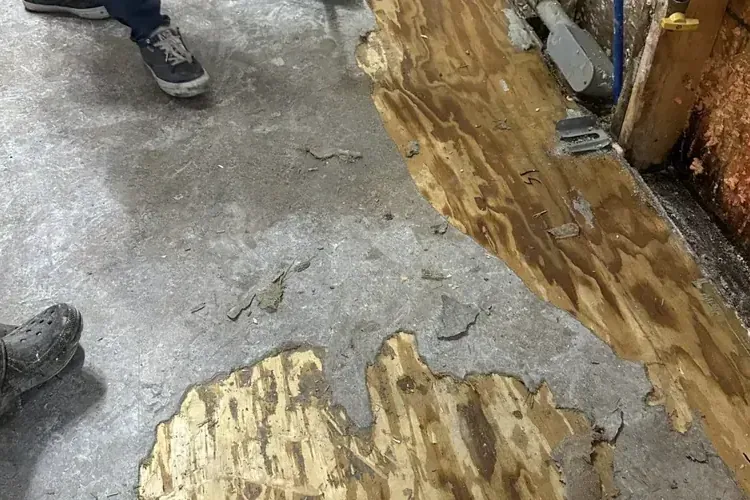
Lifted flooring revealing water that has collected on the concrete slab underneath
CluesDamp floors, warm spots
Also seenA higher water bill
Repair byA plumber
Range$2,000 to $16,000+
Typical cost

What does slab leak water damage cost in Groveland, FL?

A slab leak found early and limited to one room often lands between $2,000 and $4,500 for restoration. When the leak ran for weeks and reached the kitchen and beyond, the total can pass $16,000.

One room, caught early
$2,000 to $4,500
  • Flooring lifted
  • Baseboards removed
  • Slab drying
Kitchen and next rooms
$4,500 to $9,000
  • Cabinet bases checked
  • More flooring out
  • Added dehumidifiers
Long running leak
$9,000 to $16,000+
  • Wall repairs likely
  • Extended drying
  • Full moisture logs

What moves the number: the water category, how many square feet got wet, the material class and how soon drying began.

For a closer planning range, run the water damage cost calculator. These ranges are typical, not a quote.

Do this now

First moves when you find slab leak water damage

  1. Confirm the leak

    A meter test and a plumber's locator show where the pipe fails.

  2. Map the moisture

    Meters and a thermal camera show how far the water traveled.

  3. Remove ruined flooring

    Wet tile, carpet and baseboards come out so the slab dries.

  4. Dry the slab

    Dehumidifiers and air movers run until concrete and walls read dry.

The process

How slab leak water damage gets handled, step by step

  1. Trace

    Confirm the leak and its path.

  2. Map

    Meters outline the wet concrete.

  3. Strip

    Ruined flooring comes up.

  4. Dehumidify

    Equipment pulls moisture from the slab.

When a supply pipe leaks in or under a concrete slab, the water spreads sideways through the base of the house before it shows anywhere. By the time floors feel damp, tile may be loose and baseboards swollen. The leak is fixed by a plumber, and the restoration team handles the wet materials the leak left behind.

Signs worth checking

  • Floors that feel damp, cool or warm in one area
  • A water meter that keeps turning with every tap off
  • Water bills that jump without a change in use
  • Tile that lifts, cracks or sounds hollow
  • A musty smell near the bottom of the walls

Warm spots on the floor or a water bill that keeps climbing? The team can map where the moisture went.

Call about the damp floor

How the drying works

Concrete holds moisture for a long time, so surface drying is not enough. Flooring that sits on wet concrete is removed, dehumidifiers run to draw moisture out of the slab, and readings are repeated until the concrete matches the dry parts of the home.

Why a leak hides so well

The pipe sits where nobody can see it, and the slab spreads the water thinly across a wide area. That is why moisture mapping with meters and a thermal camera comes before any floor is torn out.

For the water on top of the slab, the water extraction page shows how it is pulled out.

Slab Leak Water Damage in short

Slab leak restoration maps where the moisture traveled, removes ruined flooring and baseboards, and dries the concrete and walls with dehumidifiers and air movers after a plumber repairs the pipe.

Service area

Slab leak water damage here and in nearby communities

Service area map

Slab leak work reaches ZIP codes 34736 and 34737, from Lexington Estates and Lexington Village to South Lake Avenue and the State Road 19 and State Road 33/50 corridors, including houses on the streets near Cherrylake Farms and the industrial park.

The same service nearby: slab leak water damage in Dade City, Mascotte, Bushnell.

Water damage restoration in Groveland · every town covered

FAQ

Slab Leak Water Damage questions, answered

How do I know the leak is under the slab?

A meter that keeps turning with every tap closed, a warm patch on the floor or the sound of running water in a quiet house are the usual signs. A plumber confirms it.

Does the plumber or the restoration team come first?

The plumber stops the leak, and the restoration team handles the water damage. On many jobs they overlap, because drying can start as soon as the water source is controlled. The water extraction page covers clearing the water that reached the floor.

Can tile and laminate stay in place?

Sometimes, if readings are low and the material is not lifting. Wet underlayment or flooring glued to damp concrete usually has to come out so the slab can dry.

How long does a slab take to dry?

It depends on how much water the concrete absorbed and how thick it is. Drying continues until repeated readings match the dry areas, not for a set number of days.

Will insurance pay for a slab leak?

Coverage varies, and many policies treat the plumbing repair and the resulting water damage separately. Ask the insurer, and keep the photos and moisture logs the team provides.

24/7 emergency dispatch

A hidden leak keeps soaking the slab, so bring in the dryers early

Describe the damp spots and the meter behavior, and the team will explain how the slab and flooring get dried.

(888) 621-2041 · extraction crews 24/7